How to Recognise a High-Quality Home or Car Fragrance
September 9, 2026
People often talk about fragrance quality as if it is only about how “premium” a scent smells. In practice, quality is easier to spot when you look at what happens after the first impression: how the fragrance behaves over time, how controllable it is in real life, and how transparent the brand is about responsible use.
If you are sceptical of vague “clean” claims and want to know what actually makes a fragrance worth buying, this article is for you. The goal is not to help you pick a scent family. It is to help you judge credibility and quality before you buy.
What high-quality fragrance really means (beyond marketing)
A high-quality home fragrance or high-quality car fragrance is usually defined by the overall user experience, not a single headline claim. You are looking for a product that feels considered: pleasant, stable, and predictable in how it performs.
In practical terms, quality often shows up as:
- Balance and coherence: the scent smells intentional rather than sharp, sour, or “perfumey” in a generic way.
- Controlled intensity: you can keep it subtle. A quality fragrance should not force a room (or car cabin) to smell intense just to be noticeable.
- Consistency over time: it does not collapse into a single harsh note after an hour. You should not get a strong alcohol blast followed by nothing.
- Purpose-fit design: a product designed for textiles behaves differently from one intended for a vent clip. Quality brands make the purpose clear.
- Responsible information: clear usage guidance, realistic longevity expectations, and accessible safety/compliance information.
Personal insight: If a fragrance only smells “good” in the first 30 seconds, that is not quality, that is a top-note trick. I encourage people to assess how it feels after a normal routine: a commute, a full afternoon at home, or a morning clean-up.
What you can observe when using a fragrance
You do not need a perfumery background to evaluate fragrance quality. A few simple observations can tell you a lot:
1) Does it stay pleasant as it dries down?
With sprays used on textiles (car mats, upholstery, curtains), the first impression can be misleading. Wait 10-20 minutes, then smell again. High-quality compositions tend to remain coherent rather than turning flat, overly sweet, or “chemical”.
2) Can you control the intensity without losing the character?
In a wellness-oriented home, you want to be able to dial scent up or down. If a product only feels effective when used at very high intensity, the issue may be the delivery format, formulation or simply a mismatch between the product and the space.
3) Does it behave appropriately on the intended surface?
A fragrance meant for textiles should not leave visible marks when used as directed, and it should not force you to spray the same spot repeatedly. Likewise, a vent-mounted car fragrance should release aroma steadily as airflow changes, rather than “dumping” scent all at once.
Personal insight: A quick test I suggest: apply only as directed, then keep a simple note in your phone at 1 hour, 1 day, and 1 week. If you find yourself needing constant re-application, the issue is often delivery and formulation, not your nose.
How to read labels and product pages like a sceptic
Many shoppers in the UK are rightly tired of greenwashed labels. Here is what is actually useful when you are trying to judge fragrance quality and trust.
Start with the basics: What is it for, and how do you use it?
Trustworthy brands state clearly:
- where the product is intended to be used (car, home textiles, room air, etc.)
- how much to apply and how often
- what not to do (for example, not spraying onto delicate surfaces)
Look for realistic claims, not “miracle” promises
Be cautious with claims that sound absolute: “safe for everyone”, “non-toxic”, “hypoallergenic”, or “chemical-free”. Fragrance is chemistry, whether ingredients originate from plants or labs. Quality brands focus on controlled use and compliance rather than sweeping wellness claims.
Check whether safety and compliance information is easy to access
At a minimum, you should expect:
- responsible usage instructions
- clear warnings (for example, to avoid eye contact and keep away from children)
- ingredient or allergen disclosures where required by the product category and local regulations
IFRA standards and SDS: what they are (and what they are not)
Two terms come up often when brands want to signal responsible manufacturing: IFRA and SDS. They can be helpful indicators, but they are not magic stamps of “best fragrance” or “safe for everyone”.
IFRA (International Fragrance Association) in plain English
IFRA is the International Fragrance Association. IFRA Standards set guidance and restrictions on how certain fragrance materials can be used, often by limiting concentration or defining categories of use (for example, leave-on skin products versus air care). When a brand says it follows IFRA, it generally means it is formulating with those limits in mind.
What IFRA suggests: the manufacturer is paying attention to established industry safety guidelines.
What IFRA does not guarantee: that a product will not irritate anyone, that it is “natural”, or that it will feel gentle in every household.
SDS (Safety Data Sheet): the transparency document
An SDS (Safety Data Sheet) is a technical document used to communicate hazards, handling, storage, and first-aid measures for chemical products. It is common in professional supply chains and can be a strong sign of operational maturity.
What an SDS helps with: understanding responsible handling and knowing whether the company can provide compliance information when asked.
What an SDS does not do: rate a fragrance’s elegance, performance, or whether you will love it.
Personal insight: If a brand cannot explain what their compliance references mean (or hides behind “proprietary blend” for everything), I treat that as a trust signal in the wrong direction. You do not need a full formula, but you do deserve clear, responsible guidance.
Why "natural", "non-toxic" and "phthalate-free" are not enough
Buzzwords can be comforting, but they rarely tell the full story.
“Natural”
Natural ingredients can still be potent irritants or allergens (many essential oils fall into this category). Natural origin does not automatically mean gentler, safer, or higher quality.
“Non-toxic”
This is usually not a regulated claim in the way people assume. A responsible brand is more likely to talk about correct use, intended application, and compliance with standards than to promise a blanket “non-toxic” status.
“Phthalate-free”
Phthalates are a group of chemicals historically used in some fragrance applications. A phthalate-free claim may be meaningful, but it does not prove that the rest of the formulation is high-quality, that performance is controlled, or that the brand is transparent about safe use.
“Clean”
There is no universal definition. Treat it as a marketing term unless it is backed by specific, verifiable information (for example, clear restricted-substance policies and compliance documentation).
Format matters: home vs car, surface vs air
A surprisingly reliable quality signal is whether the product format matches the job you want it to do.
Textile-applied fragrances (sprays for mats, upholstery, curtains)
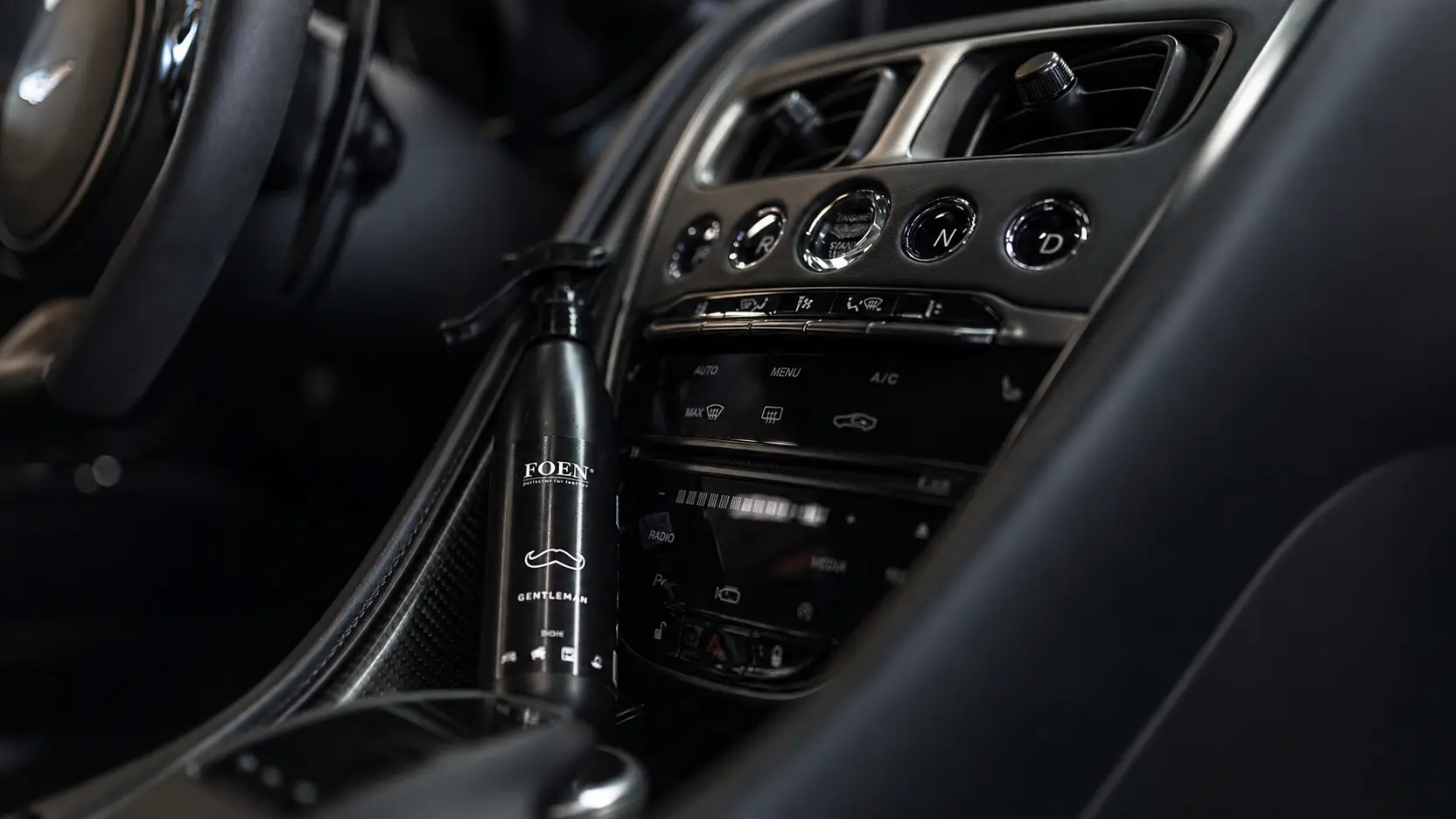
When used as directed, textiles can act as a gentle “reservoir” that releases scent gradually. A quality product in this format should come with clear application guidance so you can control intensity. FOEN’s core offer includes spray perfumes designed specifically for use on textiles such as car mats and home fabrics, which aligns with the idea of controlled application rather than constant “air blasting”.
Vent-mounted car fragrances
Vent formats can be more consistent because airflow helps distribute scent. A quality vent product should be discreet, stable, and not block the driver’s view. FOEN offers vent-mounted options (such as Wood Stick and Pulse) that focus on discreet placement and gradual release, which are practical quality considerations in a small cabin.
FOEN’s approach to controlled fragrance
FOEN’s 7 × 7 method is one example of a controlled approach to fragrance application. Rather than applying a large amount at once, the method builds the scent gradually over time. You can learn more about the 7 × 7 method and how to make your car fragrance last longer in our dedicated guide: How to Make Interior Fragrance Last Longer: The Science of Scent Throw.
How to judge brand credibility and transparency
If you want trusted fragrance brands, look for evidence of responsible choices, not just beautiful packaging.
Signals of a trustworthy manufacturer
- Clear purpose: the brand explains where the product should be used and where it should not.
- Responsible instructions: dosing guidance, ventilation reminders, and common-sense warnings.
- Accessible compliance language: references to IFRA and safety documentation explained in normal terms.
- Realistic performance: no exaggerated promises about permanent scent or health benefits.
- Customer experience focus: the product is designed to feel comfortable, not overwhelming.
Red flags
- Overreliance on vague claims (“pure”, “clean”, “chemical-free”) without specifics
- No guidance on application amount or frequency
- Claims that the product is suitable for everyone, including all allergies and all pets
- Pressure tactics and dramatic fear-based language
What to look for when comparing fragrance brands
| What to look for | Less reassuring | More reassuring |
|---|---|---|
| Product purpose | Vague: “for everywhere” with no detail | Clearly defined: car vs home, textiles vs vent, clear boundaries |
| Usage instructions | Missing or vague: “spray as needed” | Practical dosing guidance and where to apply |
| Safety/compliance info | Hidden, evasive, or only buzzwords | References to standards (for example, IFRA) explained clearly; SDS available where appropriate |
| Claims | Absolute promises | Realistic expectations |
| Performance | Strong first hit, then disappears or turns harsh | Stable, coherent scent that stays pleasant over time |
| User experience | Overpowering; hard to control | Intensity can be adjusted without losing the scent character |
A practical checklist for comparing fragrances
Use this as a quick decision tool when you are comparing a high-quality home fragrance or car fragrance.
- 1) Is the format right for my space? Textile spray, vent clip, or another format that fits the job.
- 2) Does the brand explain how to use it responsibly? Amount, frequency, where to apply, and where to avoid.
- 3) Can I control intensity? Especially important for small flats, open-plan spaces, and car cabins.
- 4) Does it stay pleasant after the first impression? Check again after 10-20 minutes and later that day.
- 5) Are compliance references meaningful? IFRA mentioned correctly (as standards), and safety documentation is not treated like a marketing badge.
- 6) Are the claims realistic? No health promises, no fear-based messaging, no “safe for everyone” absolutes.
- 7) Does the brand feel transparent? You can find straightforward information without digging.
Responsible use around children, pets and scent-sensitive people
Fragrance should remain a comfortable background element, especially in shared spaces. A few simple habits can help you keep the experience pleasant for everyone:
- Start with a low amount: Build intensity gradually rather than over-applying, especially in small rooms and car cabins.
- Follow the intended use: Apply the product only to the recommended surfaces and follow the manufacturer's instructions for dosage and ventilation.
- Consider individual sensitivity: If someone in your household is sensitive to fragrance, reduce the intensity or choose a more subtle format.
- Keep products out of reach: Store fragrance products away from children and pets and avoid direct exposure.
Natural ingredients are not automatically gentler or more suitable for every household. What matters most is using the product as intended, keeping the intensity under control, and paying attention to how people and pets respond. For more guidance on using home fragrances around babies and pets, see our guide: Are Home Fragrances Safe for Babies and Pets? What to Check First.
FAQ
What does IFRA compliant mean for home or car fragrance?
It generally means the fragrance is formulated with reference to IFRA Standards, which restrict how certain materials can be used and at what concentration depending on product category. It is a good sign of responsible manufacturing, but it does not guarantee zero irritation for every person.
Is “phthalate-free” proof that an air freshener is high quality?
No. It can be a positive detail, but quality also depends on formulation balance, controlled intensity, appropriate format, and transparent instructions and compliance information.
How can I tell if a car fragrance is too strong or poorly made?
If it smells harsh after the first few minutes, causes you to want to open windows immediately, or swings between overpowering and absent, that is usually a sign of poor balance or uncontrolled delivery. A well-made product should be adjustable and consistent.
Are “natural” fragrances automatically safer for children and pets?
No. Natural ingredients (including essential oils) can still be irritants or allergens, and some oils may be unsuitable around pets when used heavily. Prioritise low intensity, correct use, and ventilation regardless of whether ingredients are natural or synthetic.
What is an SDS and should I expect a brand to have one?
An SDS (Safety Data Sheet) is a document describing hazards, handling, and storage for chemical products. Not every consumer product page will show it, but a brand that can provide clear safety and compliance information (and understands it) is generally more trustworthy.
If you want a fragrance that focuses on controlled performance and a discreet, premium everyday experience, explore FOEN’s range and guidance at FOEN - home and car fragrances.