How to Scent Curtains Without Staining: A Fabric-Safe Fragrance Guide
October 15, 2026

If your curtains sit near a kitchen-diner, a hallway, or a damp-prone window, they pick up smells fast. The tricky part is making them smell clean and inviting without leaving tide marks, oily spots, or a darker patch where the spray landed.
The safest approach is less about the fragrance itself and more about understanding your fabric, the dyes used, and what the care label allows. Once you know whether direct application is suitable, it becomes easy to build a subtle scent that feels intentional, not overpowering.
Why curtains hold on to everyday odours
Curtains act like a soft filter. Air moves past them all day, carrying cooking aromas, traffic pollution from an open window, smoke residues, pet smells, and moisture. Those molecules cling to fibres and dust, which is why curtains can smell stale even when the rest of the room looks clean.
In UK homes, humidity also plays a part. Damp air can make musty odours linger and can slow down drying if you over-spray, increasing the risk of marks.
Before you scent: fabric, dyes, and care labels
Before you apply anything directly to curtains, check two things: what the fabric is and what the care label says. These decide whether direct misting is sensible or risky.
Fabric type: washable vs delicate
- Usually more forgiving (often washable): cotton, cotton blends, many polyesters, some linens.
- Higher risk of marking: silk, velvet/velour, viscose/rayon, acetate, blackout linings, thermal linings, and heavily structured or interlined curtains.
- Sheers and voiles: can be washable, but they show marks easily because the fabric is thin and light in colour.
Care label: what it really implies for scenting
- Machine washable / hand wash: direct scenting can be appropriate if you use a very light mist and avoid saturating.
- Dry clean only: treat direct spraying as not appropriate. Dry-clean-only often signals water sensitivity, dye instability, or a finish that can spot.
- Do not wash / do not wet: avoid direct application.
Practical insight: The most common staining complaint is not a “bad product” issue, it is over-wetting one area. Curtains hang vertically, so a slightly too-wet spray can travel down the fibre and dry into a visible line, especially on pale fabrics.
The discreet patch test (the step most people skip)
Even if the label suggests a curtain is washable, dyes and finishes can react unpredictably. A patch test takes two minutes and can save the whole set.
How to patch test without leaving a visible mark
- Choose a hidden spot: the back edge, the inner hem, or a section that folds behind the curtain return.
- Apply one very light mist (not a wet spray).
- Let it dry fully with airflow (at least a few hours, ideally overnight).
- Check in good daylight for any darkening, rings, stiffening, dye shift, or watermarking.
If you see any change at all, skip direct application and use one of the alternatives later in this article.
Practical insight: When you test, do not rub the area. Rubbing can roughen fibres (especially on velvet or viscose) and create a patch that looks different even if the liquid itself was fine.
Why DIY essential oil sprays stain (even when diluted)
Pinterest-style “essential oil + water” sprays are popular, but they are a common cause of curtain stains.
Essential oils are oils. Oil and water do not properly mix without a suitable solubiliser. So what often happens is:
- micro-droplets of oil land unevenly on the fabric,
- the oil binds to fibres and attracts dust,
- it dries into a darker spot or a ring, especially on cotton, linen, and sheers.
This risk increases with:
- light-coloured fabrics,
- thin fabrics (voiles show everything),
- heat (radiators or sunny windows can set marks),
- hard water residues if you add anything else to the mix.
| Method | Stain risk on curtains | Best for | Watch-outs |
|---|---|---|---|
| DIY essential oil + water spray | High | Hard surfaces (if appropriate), not ideal for textiles | Oil spotting, uneven distribution, lingering residue |
| Fabric perfume formulated for textiles (light mist) | Lower (still requires patch test) | Washable curtains and many everyday fabrics | Over-application can still cause watermarks |
| Indirect scenting (room air, not fabric) | Very low | Dry-clean-only, velvet, silk, lined curtains | Scent may be softer and require steady ventilation |
How to scent curtains without staining: the light-mist method
If your curtain fabric is washable and your patch test looks good, the goal is to create a fine mist that settles lightly and dries quickly.
The 15-20 cm rule (and how to avoid over-wetting)
- Hold the bottle about 15-20 cm from the curtain.
- Spray into the air in front of the fabric and let the mist settle, rather than aiming for a single spot.
- Keep your hand moving: top-to-bottom, then side-to-side.
- Focus on the outer layer of fabric, not the lining.
- Ventilate the room afterwards so moisture evaporates quickly.
Where to apply for the most “natural” result
- Lightly mist the lower half, where air movement circulates scent gently.
- Avoid soaking hems and edges (these show water lines first).
- For sheers, use fewer sprays than you think you need.
Practical insight: If you can see droplets, you have already used too much. With curtains, subtlety wins: a barely-there mist applied consistently is safer than one “big refresh” that leaves marks.
When direct application is not appropriate (and what to do instead)
There are times when spraying curtains directly is simply not worth the risk. If the label says dry clean only, the fabric is known to spot (silk, velvet, viscose), or the patch test shows any change, use an alternative.
Safer alternatives to direct spraying
- Scent the air, not the fabric: spray a fabric perfume into the room away from curtains, then let the fragrance settle naturally.
- Use a “buffer textile”: lightly scent a washable throw or cushion cover and place it near (not on) the curtains to share the fragrance in the space.
- Neutralise first: air the room, vacuum curtains with a soft brush attachment, and address damp (dehumidifier or ventilation) so odours do not keep returning.
If your curtains are musty, scent alone will not fix the cause. Dry them out and reduce humidity first, otherwise you are layering fragrance over damp.
The FOEN approach: from automotive fragrance to a home ritual
FOEN is a Polish fragrance brand known for premium, discreet automotive scents, built around the idea of creating atmosphere rather than masking smells. That experience has translated naturally into interior use, including home textiles like curtains, where subtle, controlled application matters.
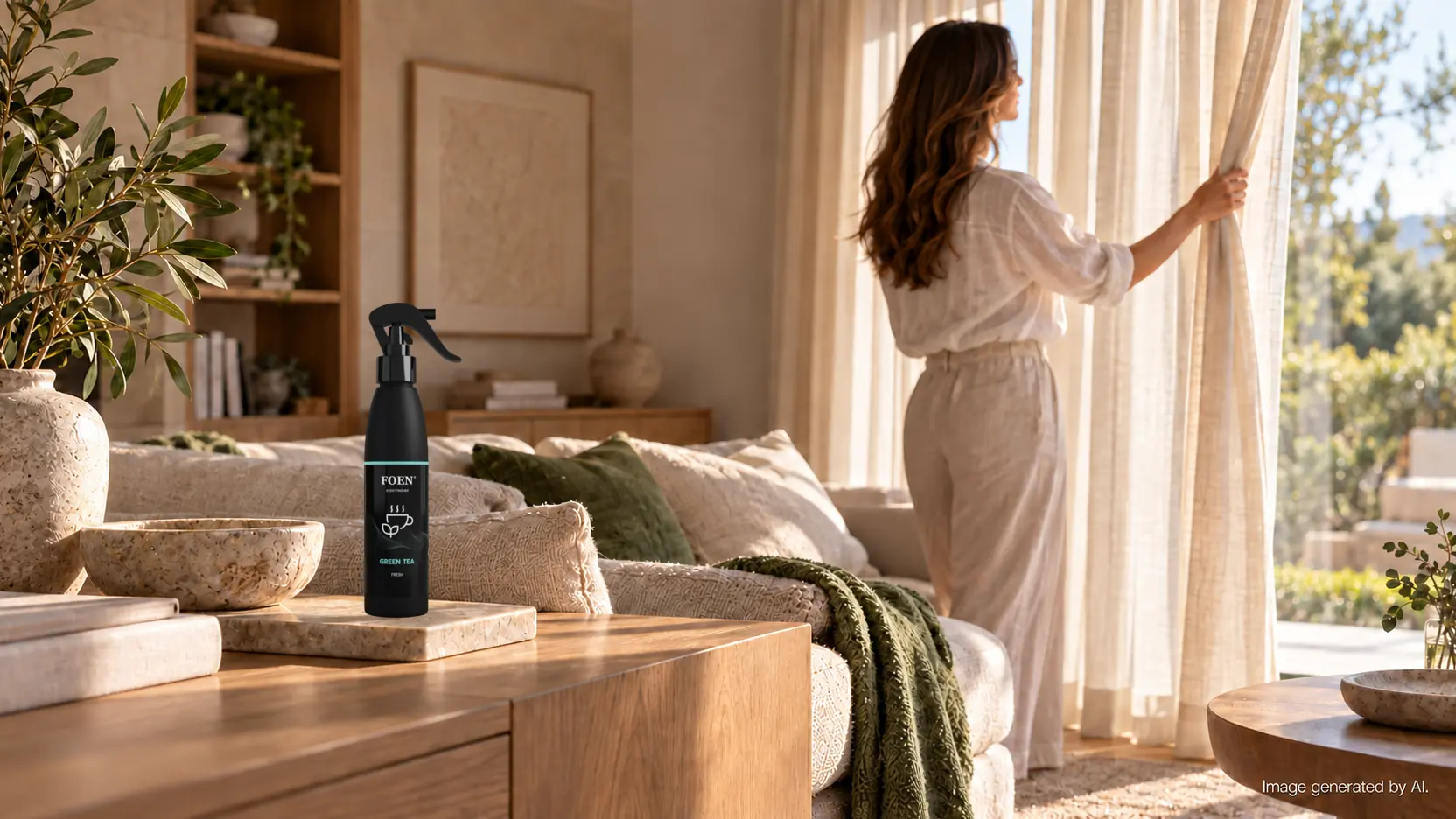
FOEN Perfumes (spray) can be used on textiles such as curtains, in line with the brand’s guidance and always after checking the material. If direct application is appropriate for your curtain fabric, FOEN recommends a gradual approach often referred to as the 7 x 7 method.
The FOEN 7 x 7 method adapted for curtains (only for suitable, patch-tested fabrics)
- Days 1-7: apply a very light mist once per day (do not saturate).
- Day 8 onwards: switch to maintenance only - top up lightly when the scent fades, rather than repeating daily.
This “build slowly” approach helps you find a comfortable intensity, which suits many wellness-minded homes where overpowering fragrance is not the goal.
Scenting curtains in homes with pets, children, or sensitive noses
If you share your home with children, pets, or anyone fragrance-sensitive, the safest strategy is controlled, minimal use and good ventilation. A pleasant home scent should never compete with breathing comfort.
Practical precautions
- Ventilation first: open a window after misting so any airborne fragrance disperses.
- Keep sprays out of reach: store products securely and do not spray when children or pets are in the immediate area.
- Avoid sleeping areas: be extra cautious with bedrooms, nurseries, and enclosed spaces.
- Prevent direct contact: do not spray pet bedding, children’s textiles, or fabrics that are likely to be chewed or mouthed.
- Start low: one light application, then reassess after a few hours. If anyone notices irritation or discomfort, stop and ventilate.
It is also wise to avoid mixing multiple scented products at once (for example, a spray plus strong candles plus plug-ins). Layering can quickly become too intense in smaller UK rooms.
A simple routine to keep curtains fresh between washes
Scenting works best when curtains are genuinely clean. Otherwise, fragrance can cling to dust and fade faster.
- Vacuum lightly every 2 weeks: use a soft brush attachment to lift dust.
- Air them out: crack a window for 10 minutes, especially after cooking.
- Manage moisture: reduce condensation around windows to prevent mustiness returning.
- Spot-check before re-scenting: if you notice any faint watermarking from past sprays, stop direct application and switch to indirect scenting.
If you want a premium, controlled fragrance option designed for both automotive and interior spaces, explore FOEN and choose a scent family that matches your style (FRESH, SWEET, UNIQUE, or INTENSIVE).
Browse FOEN home and car perfumes on the official FOEN website
FAQ
Can I spray standard body perfume on my curtains?
It is not recommended. Body perfumes can contain oils, colourants, or fixatives that may mark fabric and are not designed for textile application. If you do it at all, patch test first and use an extremely light mist from a distance.
Do essential oil room sprays stain sheer fabrics?
They can. Sheers show marks easily, and essential oils can leave oily rings when they land unevenly. If your curtains are voile or sheer linen, indirect scenting is usually safer than spraying the fabric.
How often should I scent my curtains for a lasting smell?
For washable, patch-tested curtains, start with a light application and see how long it lasts in your room. As a general approach, build gradually (for example, daily light misting for up to a week), then switch to occasional top-ups only when you stop noticing the scent.